The Ultimate Guide to the STM32 Ecosystem: Specs, Tools, and Choosing the Right MCU
Introduction
In the intricate world of embedded systems, few names command as much respect and ubiquity as STM32. As we move deeper into 2026, STMicroelectronics has not only maintained its foothold but has aggressively expanded its technological frontier, redefining what is possible at the edge. The STM32 ecosystem has evolved from a collection of general-purpose microcontrollers into a comprehensive platform driving the next generation of industrial automation, medical technology, and secure IoT infrastructure.
For engineers and product architects in the United States, the landscape of component selection has shifted. It is no longer sufficient to select a chip based solely on clock speed or memory density. Today, design decisions are dictated by supply chain resilience, adherence to security compliance like the Cyber Resilience Act (CRA), and the ability to integrate advanced AI capabilities locally. This guide serves as the definitive resource for navigating the massive STM32 portfolio, offering a strategic framework for selecting the right hardware, optimizing development workflows, and ensuring long-term product viability in a competitive global market.
From the revolutionary shift to 18nm FD-SOI process technology to the integration of dedicated Neural Processing Units (NPUs), we will dismantle the technical specifications and strategic considerations that define the modern STM32 development experience.
1. The Silicon Foundation: Architecture and the 18nm Evolution
To understand the trajectory of the STM32 family, one must first analyze the silicon foundation upon which it is built. STMicroelectronics is currently executing a pivotal migration from traditional 40nm and 28nm nodes to a groundbreaking 18nm Fully Depleted Silicon-on-Insulator (FD-SOI) platform. This is not merely a shrink in die size; it is a fundamental architectural shift designed to manage the competing demands of high-performance edge computing and extreme energy efficiency.
The Impact of 18nm FD-SOI
Developed in collaboration with Samsung Foundry, the 18nm node introduces a 50% increase in the performance-to-power ratio compared to previous generations. For US-based developers working on battery-constrained IoT devices or thermal-sensitive industrial gateways, this translates to cooler operation and extended field life. The architecture enables higher RF performance and the integration of embedded Phase-Change Memory (ePCM), which offers superior endurance and write speeds compared to traditional Flash memory.
The Evolution of the Cortex-M Core
The STM32 ecosystem is anchored by the ARM Cortex-M processor family, which has evolved to meet diversifying needs:
- Cortex-M0/M0+: The foundation of the STM32G0 and C0 series, focused on replacing 8-bit legacy systems with 32-bit efficiency at a minimal price point.
- Cortex-M3/M4: The workhorses of the industry (STM32F1, F3, F4, G4), introducing DSP instructions and Floating-Point Units (FPU) for mixed-signal processing.
- Cortex-M33: Featured in the STM32U5 and L5, bringing TrustZone security to the mainstream, essential for meeting modern IoT security standards.
- Cortex-M7 & M85: The performance leaders. The Cortex-M7 drives the STM32H7 series, while the M85 (utilizing Helium technology) sets the stage for future high-bandwidth vector processing.
2. High-Performance Computing: STM32H7 and the N6 NPU Revolution
For applications requiring real-time responsiveness combined with heavy computational throughput—such as industrial robotics, avionics, and advanced HMI—the high-performance STM32 series remains the industry benchmark.
The STM32H7: Dual-Core Dominance
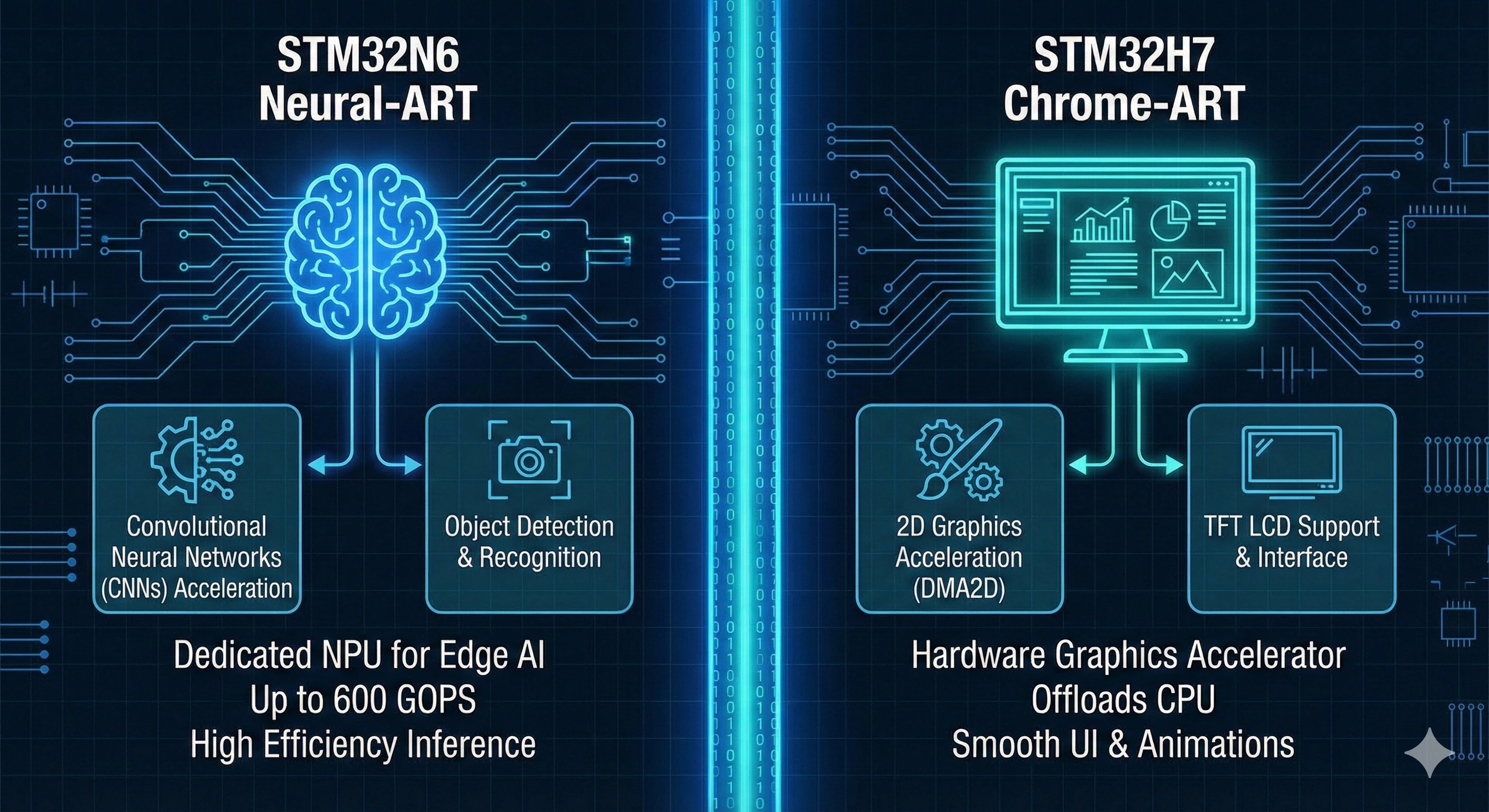
The STM32H7 series utilizes a dual-core architecture, typically pairing a high-performance Cortex-M7 (running up to 480 MHz or higher) with a Cortex-M4. This asymmetric multiprocessing (AMP) approach allows developers to partition tasks effectively. The M7 core handles heavy lifting such as high-resolution graphics, complex algorithms, or TCP/IP stacks, while the M4 core manages deterministic, real-time I/O control and sensor data acquisition. This separation ensures that a heavy UI load never compromises the safety-critical control loop—a vital requirement for US industrial compliance.
The STM32N6: Hardware-Accelerated AI
The 2026 landscape is defined by the shift from software-based AI to hardware acceleration. The STM32N6 series represents a paradigm shift by integrating a proprietary Neural Processing Unit (NPU) known as the Neural-ART accelerator.
- Edge AI Performance: Unlike running inference on a Cortex-M7, which consumes significant CPU cycles and power, the Neural-ART accelerator handles Convolutional Neural Networks (CNNs) and Recurrent Neural Networks (RNNs) in dedicated hardware.
- Computer Vision: When paired with the N6’s integrated Image Signal Processor (ISP), the NPU enables real-time object detection, face recognition, and anomaly detection at high frame rates. This is critical for next-gen smart security cameras and autonomous drones, allowing them to process video streams locally without cloud latency.
3. Ultra-Low-Power Innovation: STM32U5 and Autonomous Peripherals
In the medical and wearable sectors, battery life is the primary design constraint. The STM32 ultra-low-power portfolio, led by the STM32U5 series, addresses this with architectural innovations that go beyond simple clock gating.
Low Power Background Autonomous Mode (LPBAM)
The defining feature of the STM32U5 is the Low Power Background Autonomous Mode (LPBAM). Traditionally, a microcontroller must wake the CPU to process peripheral events (like reading an I2C sensor or moving data via DMA). LPBAM changes this by allowing specific peripherals and the DMA controller to operate independently while the CPU remains in a deep sleep mode (Stop mode).
Real-World Application: A wearable health monitor can use LPBAM to continuously sample an accelerometer and ECG sensor, buffering the data into SRAM. The high-power CPU only wakes up when a specific threshold is breached or the buffer is full. This architecture can extend battery life from days to weeks.
Dynamic Voltage Scaling
The STM32U5 integrates a high-efficiency Switch-Mode Power Supply (SMPS) and Low Dropout (LDO) regulator directly on-chip. This allows for dynamic voltage scaling, where the power supply adjusts in real-time based on the processing workload, achieving active power consumption metrics as low as sub-19µA/MHz.
4. Wireless Connectivity and Matter Integration
The fragmentation of the IoT market is being resolved through the adoption of the Matter protocol. STMicroelectronics has aligned its wireless STM32 roadmap to support this unified standard, crucial for interoperability in the US smart home market.
STM32WBA and Matter
The STM32WBA series, built on the Cortex-M33, is engineered specifically for Matter over Thread. It supports Bluetooth Low Energy (BLE) 5.4 for easy device commissioning and IEEE 802.15.4 for mesh networking. By integrating the radio stack with a secure application processor, the WBA series allows developers to build "Matter-native" devices that work seamlessly with Apple Home, Google Home, and Amazon Alexa ecosystems without requiring proprietary bridges.
Long-Range Connectivity: STM32WL
For industrial and agricultural applications requiring multi-mile range, the STM32WL series integrates LoRa modulation directly onto the silicon. This System-on-Chip (SoC) eliminates the need for external LoRa modules, reducing BOM cost and footprint. It is the ideal solution for US AgTech deployments, smart metering, and remote asset tracking where cellular connectivity is too power-hungry or expensive.
5. Bridging the Gap: The Move to MPUs (STM32MP Series)
As user interfaces become more sophisticated, resembling smartphone experiences, the memory constraints of microcontrollers become a bottleneck. This necessitates a transition to Microprocessors (MPUs) capable of running Linux.
STM32MP1 and MP2
The STM32MP series bridges the gap between the MCU and MPU worlds.
- STM32MP1: Features single or dual Cortex-A7 cores for Linux, alongside a Cortex-M4 for real-time tasks. It allows developers to reuse their STM32 MCU code on the M4 core while leveraging the vast Linux driver ecosystem on the A7 cores for connectivity and UI.
- STM32MP2 (64-bit): The newer MP2 series upgrades to 64-bit Cortex-A35 cores and integrates an NPU for edge AI. This capability is essential for industrial gateways that must aggregate data from hundreds of sensors, process it locally using AI, and securely transmit insights to the cloud.
The Complexity of Linux
Transitioning to an MPU requires a shift in workflow. Unlike the bare-metal environment of an MCU, MPUs use external DDR memory and require a Power Management IC (PMIC). Software development moves from direct register access to writing kernel drivers and configuring Device Trees. ST supports this via OpenSTLinux, a Yocto-based distribution that standardizes the Linux build process.
6. The Development Ecosystem: Tools and Workflow
A robust hardware platform is useless without an efficient development workflow. The STM32 ecosystem offers a flexible toolchain that accommodates both traditional embedded engineers and modern software developers.
STM32CubeMX and Code Generation
The workflow typically begins in STM32CubeMX. This graphical tool allows engineers to map pins, configure clock trees, and set up middleware (USB, TCP/IP, File System). It generates the initialization C-code, providing a solid foundation based on the HAL (Hardware Abstraction Layer) or LL (Low-Layer) drivers.
VS Code vs. STM32CubeIDE
While STM32CubeIDE (Eclipse-based) remains the official integrated environment, there is a massive trend toward Visual Studio Code (VS Code).
The VS Code Advantage: Through the official STM32 VS Code extension, developers can leverage IntelliSense, Copilot AI coding assistants, and a vast library of plugins. The workflow utilizes CMake or Makefile projects generated by CubeMX, bridging the gap between hardware configuration and modern code editing.
CI/CD Integration: The move to text-based build systems (CMake/Ninja) facilitates Continuous Integration/Continuous Deployment (CI/CD) pipelines. This allows teams to run automated builds and unit tests in the cloud (using simulators or HIL farms) before deploying firmware to physical prototypes.
7. AI at the Edge: Workflow Options
ST offers two distinct paths for integrating AI into STM32 devices, catering to different levels of data science expertise.
STM32Cube.AI
For teams with data scientists and pre-trained models (TensorFlow Lite, Keras, ONNX, PyTorch), STM32Cube.AI is the tool of choice. It acts as a compiler/quantizer, converting a neural network into optimized C-code that fits the memory footprint of the target MCU. It provides detailed analysis of RAM/Flash usage and inference time, allowing engineers to trade off accuracy for performance.
NanoEdge AI Studio
For embedded engineers without deep AI expertise, NanoEdge AI Studio offers an Automated ML (AutoML) approach. It excels in anomaly detection (e.g., detecting motor bearing failure via vibration analysis). A unique feature is on-device learning; the library can learn the “normal” behavior of a machine after deployment, adapting to the specific operating conditions of each installation.
8. Strategic Selection Framework for USA-Based Engineering
For engineers and procurement managers in the United States, selecting an STM32 MCU involves navigating a complex web of logistics and regulations.
8.1 TAA Compliance and Supply Chain Security
For projects involving US government contracts, aerospace, or critical infrastructure, adherence to the Trade Agreements Act (TAA) is mandatory. While the silicon itself is global, ensuring your supply chain sources from authorized distributors is critical. Engineers should utilize authorized US-based distributors like DigiKey, Mouser, and Arrow to ensure chain-of-custody and avoid counterfeit components, which remain a significant risk in the gray market.
8.2 BOM Resilience and Multi-Sourcing
The post-2020 chip shortage taught the industry a painful lesson. When selecting an STM32 part, perform a “BOM Scrub” using tools like SiliconExpert.
- Pin-to-Pin Compatibility: Ensure your PCB design can accommodate alternative parts. For example, many STM32 chips in the same package (e.g., LQFP64) are pin-compatible across different flash sizes and even different families (e.g., F4 to G4), providing a bailout option if your primary SKU goes out of stock.
- Lifecycle Status: Only select parts marked “Active.” Avoid “NRND” (Not Recommended for New Designs). STMicroelectronics is famous for its 10-year longevity commitment, renewed annually, which is a critical factor for industrial and medical products with long service lives.
8.3 Total Cost of Ownership (TCO)
Do not optimize solely for unit price. Factor in the cost of certification (FCC, UL), potential tariffs on peripheral components, and development time. The rich STM32 software ecosystem often reduces software engineering hours—the most expensive resource in the US—thereby lowering the overall project cost despite potentially higher silicon costs compared to bare-bones competitors.
9. Frequently Asked Questions (PAA & Technical)
Which STM32 board is best for beginners in 2026?
The STM32 Nucleo-64 series (specifically the NUCLEO-G474RE or NUCLEO-L476RG) remains the gold standard. It features onboard debugging (ST-LINK), Arduino headers for expansion, and supports the latest software tools. It balances performance with ease of use better than the complex Evaluation boards.
Is STM32 better than ESP32 for industrial applications?
For strict industrial controls, STM32 is generally superior due to its deterministic interrupt handling, vast peripheral set (CAN-FD, high-res timers), and extensive safety certifications (SIL). ESP32 excels in low-cost Wi-Fi/Bluetooth applications but often consumes more power and lacks the real-time precision of the Cortex-M cores found in STM32.
How do I migrate from Arduino to STM32?
The transition is smoothed by the STM32duino project, which allows you to program STM32 boards using the Arduino IDE. However, for professional development, it is recommended to move to STM32CubeIDE or VS Code to leverage full debugging capabilities (breakpoints, register inspection) that the Arduino IDE lacks.
What is the best way to implement Over-the-Air (OTA) updates on STM32?
Using the dual-bank flash feature available on many STM32 series (like the L4, G4, U5) is the most robust method. This allows the device to download the new firmware to Bank 2 while running from Bank 1. Upon verification, the system reboots and swaps banks. This ensures that if an update fails, the device can fall back to the previous working firmware, preventing “bricking.”
How does the STM32 ecosystem help meet the Cyber Resilience Act (CRA)?
The STM32Trust framework provides the necessary building blocks for CRA compliance. This includes Secure Boot (Root of Trust), Secure Firmware Update, and hardware cryptographic accelerators. Achieving SESIP Level 3 or PSA Certified status using these tools demonstrates “Security by Design,” a key requirement of 2026 regulations.
Can I simulate STM32 hardware in the cloud for CI/CD?
Yes. Platforms like Renode and QEMU allow for the emulation of STM32 hardware. These can be integrated into GitHub Actions or Jenkins pipelines to run headless unit tests on compiled binaries every time code is committed, ensuring software stability before the firmware ever touches a physical chip.
10. Conclusion: Future-Proofing Your Design
As we look toward the latter half of the decade, the STM32 platform is positioning itself as the bridge between the physical and digital worlds. The convergence of ultra-low-power processing, hardware-accelerated AI, and unified connectivity standards like Matter is enabling a new class of intelligent devices.
For the US-based engineer, the path forward involves more than just mastering code; it requires a holistic view of the ecosystem. It means leveraging the power of the STM32U5 to meet sustainability goals, utilizing the STM32H7 and N6 for edge intelligence, and securing the supply chain through strategic component selection.
By adopting the tools and strategies outlined in this guide—from VS Code integration to TAA-compliant sourcing—developers can build systems that are not only technically superior but commercially resilient. The STM32 is more than a microcontroller; it is a long-term technology partnership that ensures your innovations remain relevant in 2026 and beyond.
Technical Appendix: Quick Specs for 2026 Selection
| Feature | STM32G0/C0 | STM32U5 | STM32H7 | STM32WBA | STM32MP2 |
|---|---|---|---|---|---|
| Primary Use | Cost-sensitive, 8-bit replacement | Low-power wearables, medical | High-perf industrial, Avionics | Smart Home (Matter), BLE | Gateways, Linux HMI, Edge AI |
| Core | Cortex-M0+ | Cortex-M33 | Cortex-M7 + M4 | Cortex-M33 | Cortex-A35 + M33 |
| Key Spec | Lowest BOM cost | LPBAM, <19µA/MHz | 480+ MHz, Dual Core | Bluetooth 5.4 | 64-bit Linux |
| AI Capable | Minimal (NanoEdge) | Moderate (Cube.AI) | High (Neural-ART) | Moderate | Very High (NPU) |
| Security | Standard | TrustZone, SESIP L3 | STM32Trust | SESIP L3 | Secure Boot, TEE |