STM32 vs ESP32 for Industrial Application: Navigating Industry 4.0 Requirements
In the rapidly evolving landscape of Industry 4.0, the selection of a microcontroller unit (MCU) is a high-stakes decision that dictates the reliability, scalability, and security of an entire manufacturing ecosystem. As industrial environments transition toward hyper-connected frameworks—often termed the Industrial Internet of Things (IIoT)—engineers face a critical crossroad when evaluating the stm32 vs esp32 for industrial application. This choice transcends simple hardware specifications; it involves weighing the rigorous demands of real-time deterministic control against the increasing necessity for seamless edge-to-cloud connectivity.
Industrial standards demand microcontrollers capable of operating within harsh electromagnetic environments while maintaining long-term lifecycle support. The STM32 series, built on the ARM Cortex-M architecture, has traditionally served as the backbone of industrial automation due to its vast peripheral sets and proven robustness in mission-critical systems. Conversely, the ESP32 has emerged as a disruptive force, offering integrated wireless stacks and dual-core processing at a competitive price point. However, in high-stakes deployments where downtime results in significant financial loss, factors such as hardware abstraction maturity, power consumption, and thermal stability become the deciding metrics. This comprehensive guide explores how these two silicon giants align with modern IIoT standards, providing a foundation for selecting the optimal architecture for resilient industrial infrastructure.
Defining Industrial Grade: Beyond Standard Silicon
In the context of high-performance microcontrollers like the STM32H7 and U5 series, the "Industrial Grade" designation signifies a departure from conventional silicon limits, establishing a new baseline for reliability in hostile operating environments. The cornerstone of this classification is the expanded junction temperature ($T_j$) benchmark. While consumer electronics often falter above +85°C, premier industrial silicon is engineered to withstand junction temperatures spanning from -40°C to +125°C, with specialized automotive-grade variants pushing the envelope to +140°C or +150°C.
This thermal resilience is not merely a specification sheet statistic; it is a structural necessity. In high-density power electronics, under-the-hood automotive integration, and geothermal monitoring, ambient heat combines with internal self-heating to push silicon toward thermal runaway. Industrial-grade MCUs mitigate this through advanced packaging technologies and lower thermal resistance ($R_{thJA}$), ensuring structural integrity and timing precision even when the environment attempts to compromise the die.
Beyond thermal resilience, industrial-grade status is defined by deterministic performance. In high-stakes automation, the predictability of execution is as vital as raw processing speed. A millisecond of jitter in a robotic arm controller can result in welding defects or safety violations. The STM32 series achieves determinism through an architecture designed to eliminate execution variance. It features a sophisticated Nested Vectored Interrupt Controller (NVIC) with fixed-latency response times and dedicated hardware accelerators—such as the ART Accelerator™—that allow zero-wait-state execution from Flash memory. By offloading time-critical tasks like motor control loops or complex signal processing to these dedicated hardware blocks, the system ensures that mission-critical logic executes with microsecond-level consistency, regardless of the peripheral load or background communication tasks.
Furthermore, true industrial silicon integrates robust hardware-level integrity features. This includes Error Correction Code (ECC) across the entire memory subsystem (Flash, SRAM, and Tightly Coupled Memory) to mitigate soft errors caused by alpha particles or electromagnetic interference (EMI). Built-in hardware self-tests (BIST), clock security systems (CSS) that detect oscillator failure, and dual-window watchdogs provide a safety net for autonomous recovery in the event of transient faults. By synthesizing these extreme thermal tolerances with rigorous deterministic execution and hardware-level error mitigation, industrial-grade MCUs redefine reliability in environments where system failure is not an option.
STM32 Architecture: The Deterministic Powerhouse
The STM32 microcontroller family, developed by STMicroelectronics, represents a pinnacle of embedded engineering built upon the ARM Cortex-M processor heritage. This 32-bit RISC foundation provides a standardized architecture that prioritizes high-performance throughput, power efficiency, and deterministic behavior. By utilizing the Cortex-M series—ranging from the cost-effective M0+ to the high-performance M4, M7, and the secure M33 cores—the STM32 architecture delivers a consistent instruction set and a sophisticated interrupt management system.
The NVIC is vital for precision control, enabling low-latency interrupt handling and "tail-chaining," a technique where the processor services back-to-back interrupts without the overhead of saving and restoring state in between. This ensures that the processor can respond to real-time events—such as a limit switch trigger or an over-current fault—with predictable, nanosecond-level accuracy.
The software backbone of this architecture is the Hardware Abstraction Layer (HAL) ecosystem. The STM32 HAL provides a high-level, vendor-independent API that abstracts the complexities of hardware registers and peripheral configurations. This abstraction allows developers to write portable code across different STM32 series without needing to re-engineer core drivers for every hardware iteration. When combined with the Low-Layer (LL) drivers—which offer a leaner, register-level interface for performance-critical paths—the ecosystem provides a flexible framework for balancing development speed with execution efficiency. Tools like STM32CubeMX further enhance this ecosystem by automating peripheral initialization, clock tree configuration, and pin-multiplexing, ensuring that the hardware-software interface is configured correctly from the start.
For applications requiring complex multitasking and rigorous timing, RTOS (Real-Time Operating System) integration is a fundamental component of the STM32 environment. The architecture offers seamless support for industry standards such as FreeRTOS, Azure RTOS (ThreadX), and Zephyr. This integration allows developers to partition complex control loops into discrete, prioritized tasks managed by a preemptive scheduler. In precision control scenarios, such as industrial robotics or high-frequency power electronics, the RTOS ensures that safety-critical tasks are never starved of CPU time. By leveraging RTOS primitives—including semaphores, mutexes, and message queues—system architects can manage resource sharing and inter-process communication without compromising determinism. Furthermore, the synergy between the core’s Direct Memory Access (DMA) controllers and the RTOS allows for autonomous data transfers between peripherals and memory, freeing the CPU to focus on high-level algorithmic processing while maintaining the integrity of the real-time control loop.
ESP32 Architecture: The Dual-Core Disruptor
The ESP32 architecture represents a paradigm shift in embedded systems by employing a dual-core configuration—traditionally based on the Tensilica Xtensa LX6/LX7 and more recently moving toward the RISC-V ISA in the ESP32-C and H series. This multi-core strategy is not merely for raw processing power, but for the strategic separation of the communication subsystem from the application logic.
In the ESP32’s symmetric multiprocessing (SMP) environment, the system typically designates one core as the Protocol CPU (PRO_CPU) and the other as the Application CPU (APP_CPU). The PRO_CPU is dedicated to managing the complex, timing-sensitive requirements of the Wi-Fi and Bluetooth stacks. Because wireless protocols require nanosecond-level precision for packet handling, beacon monitoring, and clock synchronization, offloading these tasks ensures that the radio link remains stable regardless of the user’s code complexity.
Conversely, the APP_CPU provides a dedicated execution environment for user-defined algorithms, sensor fusion, and peripheral management. This separation mitigates the "jitter" commonly found in single-core systems, where heavy computational tasks might delay critical networking interrupts, leading to dropped packets or connection timeouts. By pinning tasks to specific cores via the FreeRTOS scheduler, developers gain a degree of deterministic control over execution that rivals single-core efficiencies.
Newer variants, such as the ESP32-S3, introduce vector instructions for accelerating neural network workloads, positioning the ESP32 as a leader in the "AIoT" (Artificial Intelligence of Things) space. Furthermore, the integration of RISC-V in the ESP32-C6 and ESP32-H2 series optimizes this architecture by providing a leaner, open-source instruction set that improves power efficiency and reduces the hardware footprint. Whether using Xtensa or RISC-V, the dual-core advantage lies in this functional isolation: the ESP32 operates as a reliable communication gateway and a high-performance logic controller simultaneously, ensuring seamless connectivity without compromising application responsiveness.
STM32 vs ESP32 for Industrial Application: Industrial Wired Protocols
In the demanding environment of factory automation and process control, the choice of communication protocol often dictates the reliability of the entire system. When evaluating the stm32 vs esp32 for industrial application, the support for high-bandwidth, deterministic wired protocols like FDCAN, EtherCAT, and Time-Sensitive Networking (TSN) becomes a primary differentiator. While both microcontrollers offer basic UART/SPI connectivity, their hardware architectures handle industrial-grade networking with varying degrees of proficiency.
Native FDCAN Integration
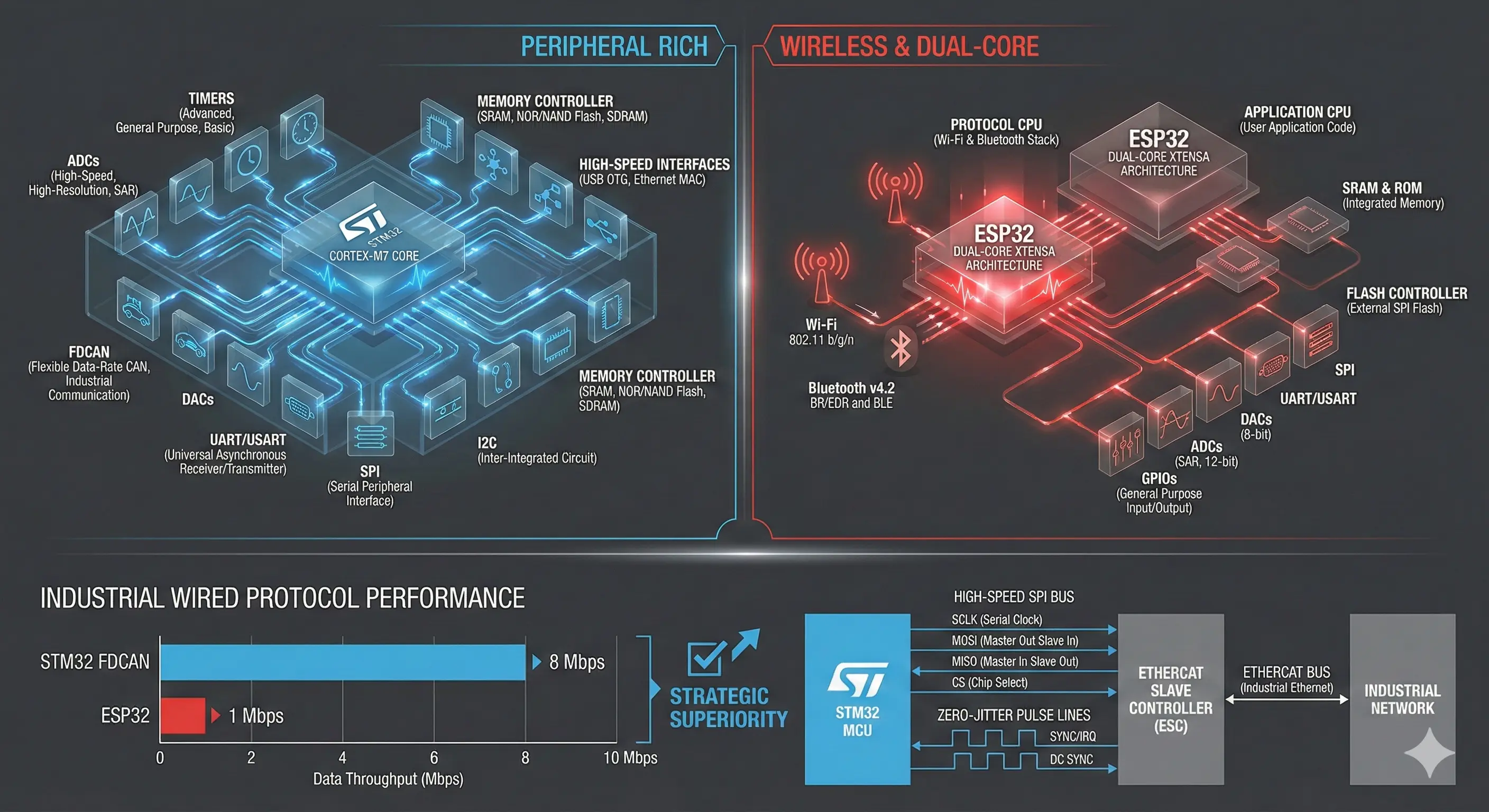
The transition from standard CAN 2.0B to CAN Flexible Data-rate (FDCAN) is essential for modern industrial systems that require higher data throughput and larger payloads (up to 64 bytes per frame compared to the traditional 8 bytes). The STM32 ecosystem, particularly the STM32G4, STM32H7, and STM32U5 series, features integrated FDCAN controllers capable of bit rates up to 8 Mbps. These controllers are designed for robust error handling and offer multiple hardware filters, which offload message sorting tasks from the CPU, preserving cycles for control logic.
In contrast, the ESP32 features a Two-Wire Automotive Interface (TWAI), which is functionally compatible with CAN 2.0B but lacks native FDCAN support. While the ESP32 can communicate at 1 Mbps, it struggles to meet the requirements of modern high-speed sensor networks or complex motor control systems that rely on the extended data fields provided by FDCAN. For engineers prioritizing native, high-speed fieldbus integration, the STM32 is the superior choice.
EtherCAT and Deterministic Timing
EtherCAT (Ethernet for Control Automation Technology) is the industry standard for real-time Ethernet, requiring precise hardware synchronization and sub-millisecond cycle times. Neither the ESP32 nor the standard STM32 chips typically include a native EtherCAT Slave Controller (ESC) on-die (with few exceptions in specialized STM32 lines). However, the STM32 architecture is significantly better optimized for interfacing with external ESCs like the LAN9252.
The STM32’s Flexible Static Memory Controller (FSMC) or Quad-SPI interfaces allow for low-latency, parallel communication between the MCU and the EtherCAT chip. Furthermore, the STM32's sophisticated DMA and interrupt handling ensure that the deterministic requirements of EtherCAT are met without jitter. The ESP32, while powerful, often faces challenges in deterministic timing due to its underlying Wi-Fi/Bluetooth background tasks and the inherent overhead of the ESP-IDF framework, which prioritizes wireless throughput over real-time bus determinism.
Verdict for Industrial Networking
When analyzing stm32 vs esp32 for industrial application, the STM32 wins on wired protocol versatility and determinism. Its hardware-level support for FDCAN and its seamless integration with EtherCAT and Profinet ecosystems make it the industry's go-to for complex, wired automation. The ESP32 remains an excellent choice for wireless gateways, but for the backbone of an industrial wired network, the STM32 provides the necessary robustness and timing precision.
Wireless Connectivity: Integrated SoC vs. Modular Versatility
The architectural philosophy regarding wireless communication represents the most significant divergence between the ESP32 and STM32 ecosystems. The ESP32 series, particularly the newer ESP32-C6 and ESP32-S3 variants, is designed as a communication-first SoC. By integrating Wi-Fi 6 (802.11ax) and Bluetooth Low Energy (BLE) 5.3 onto a single silicon die, Espressif eliminates the complexities associated with high-frequency RF circuit design for the end-user. The inclusion of Wi-Fi 6 is particularly transformative, offering Target Wake Time (TWT) for improved battery life and OFDMA for higher efficiency in congested network environments—a common scenario in factories crowded with sensors.
This integration ensures a unified power management system where the radio’s sleep states are tightly coupled with the CPU cores, drastically reducing the Bill of Materials (BOM) and shrinking the physical PCB footprint. Furthermore, Espressif’s dominance in the Matter protocol standard allows for rapid integration into interoperable smart building and industrial ecosystems.
In contrast, the STM32 ecosystem historically favors a modular RF approach, though this has evolved with the introduction of the STM32WB (Wireless Bluetooth/Zigbee) and STM32WBA lines. For high-performance applications using the STM32H7 or F4 series, wireless connectivity is typically achieved through external transceiver modules connected via SPI, SDIO, or UART. While this increases hardware complexity and per-unit cost, it provides unparalleled flexibility. Developers can decouple the application logic from the radio technology, allowing a single base design to support various protocols—such as LoRaWAN, Zigbee, or proprietary Sub-GHz bands—simply by swapping the external module. This modularity also isolates the main MCU from RF-induced noise and simplifies the certification process, as modular RF components often come pre-certified (FCC/CE/IC).
Ultimately, the ESP32 provides a streamlined, cost-effective path for standard IoT applications requiring high-bandwidth Wi-Fi and BLE out of the box. The STM32’s modularity, while more demanding in terms of PCB layout and driver development, serves industrial use cases where specific long-range protocols or the ability to upgrade radio hardware without redesigning the core processing unit are critical requirements.
Security and Compliance: The New Industrial Battlefield
As industrial systems connect to the cloud, the attack surface expands exponentially. The platform’s security architecture must be anchored in a hardware-based "security-by-design" philosophy.
The STM32 ecosystem utilizes the STM32Trust framework, often centering on an Immutable Root of Trust (RoT). Unlike software-based solutions, this RoT is embedded directly into the silicon during manufacturing, providing a permanent, non-bypassable foundation for all subsequent cryptographic operations. By establishing a hardware-bound identity, the system guarantees the integrity of the Secure Boot process, ensuring that only authenticated, untampered firmware can execute on the device. STM32 H5 and U5 series push this further with ARM TrustZone, creating a hardware-isolated Trusted Execution Environment (TEE) that physically separates sensitive cryptographic keys from the main application code.
To validate these security claims, STM32 platforms frequently target PSA Certified Level 3 and SESIP Level 3 standards. While lower levels focus on software isolation, Level 3 mandates significant protection against sophisticated physical attacks, including side-channel analysis (SCA) and hardware fault injection (glitching).
Espressif has rapidly matured its security stance with the ESP32-S3 and C-series. These chips feature Secure Boot V2, flash encryption (XTS-AES), and digital signature peripherals that prevent unauthorized firmware cloning. While historically perceived as less secure than the vault-like STM32 secure elements, modern ESP32 iterations are achieving PSA certifications and offer sufficient protection for many connected sensor applications.
This rigorous technical framework serves as a critical enabler for compliance with the EU Cyber Resilience Act (CRA) and IEC 62443 industrial security standards. The CRA introduces mandatory cybersecurity requirements for hardware products, emphasizing vulnerability management and the duty of care. The combination of an immutable RoT and PSA certification directly addresses the CRA’s requirements for secure default configurations. By documenting these hardware-enforced safeguards, manufacturers can streamline the conformity assessment process, reducing liability in an increasingly regulated global landscape.
Longevity and Supply Chain Resilience
In the industrial sector, product lifecycles are measured in decades, not years. An assembly line controller installed today is expected to remain operational and repairable in 2040.
STMicroelectronics formally guarantees a minimum 10-year product lifecycle for its STM32 series, with many lines extending to 15 years. This "Rolling 10-Year Commitment" is renewed annually, providing a stable foundation for industrial, medical, and mission-critical applications where certification costs are astronomical. ST's multi-fab strategy (manufacturing across Europe and Asia) helps mitigate supply chain risks, although the 2020-2022 chip shortage highlighted that no vendor is immune to global disruptions.
Espressif, while younger, has demonstrated impressive commitment to longevity, guaranteeing 12-year availability for its core SoCs like the ESP32 and ESP32-S series. However, the rapid pace of iteration in the IoT consumer market can sometimes lead to confusion regarding module availability versus SoC availability. For industrial designers, verifying the specific status of the module form factor is crucial.
Strategic procurement strategies now include maintaining significant safety stock of critical silicon and establishing deep-seated partnerships with tier-one component manufacturers. This proactive approach mitigates the risks associated with market volatility. In the event of inevitable technological shifts, the STM32's HAL and ESP32's IDF both offer abstraction layers that ease migration to successor technologies, though STM32's pin-to-pin compatibility within families often makes hardware upgrades less painful.
Power Efficiency: The Nano-Power Paradigm
The evolution of autonomous IoT is driven by nano-power technology, prioritizing the radical reduction of quiescent current to maximize battery longevity.
The STM32U5 series exemplifies this with its ultra-low-power architecture, achieving current draws in the nano-amp range during deep sleep while retaining RAM content. Innovations like the Low Power Background Autonomous Mode (LPBAM) allow peripherals (ADC, I2C, SPI) to function and wake the device only when specific thresholds are met, keeping the power-hungry CPU core dormant for 99% of the time.
The ESP32, traditionally known for higher power consumption due to its Wi-Fi heritage, has made strides with the RISC-V based ESP32-C series and its Ultra-Low-Power (ULP) Co-processor. The ULP allows the main cores to sleep while a low-power state machine monitors sensors. However, the active power consumption of Wi-Fi transmission (often >250mA peaks) remains a challenge compared to non-wireless STM32 applications.
The engineering imperative lies in balancing this nano-power baseline against active-state thermal envelopes. Effective power management must synchronize ultra-low-power consumption with transient mitigation strategies. For battery-operated industrial sensors, the STM32 generally wins on pure micro-amp efficiency, but for devices that must connect to Wi-Fi, the ESP32 offers the most integrated solution, provided the duty cycle is aggressively managed.
Development Ecosystem: Toolchains and Time-to-Market
The STM32 development ecosystem, epitomized by STM32CubeMX and STM32CubeIDE, represents a structured, high-assurance approach. CubeMX provides a graphical interface for clock tree configuration and peripheral initialization, generating boilerplate code that integrates seamlessly with professional toolchains like IAR Embedded Workbench and Keil MDK. IAR is the industry benchmark for safety-critical applications, offering advanced static analysis, deep trace debugging, and MISRA-C compliance. This ecosystem prioritizes deterministic performance and rigorous certification paths common in automotive and industrial sectors.
In stark contrast, the Espressif IoT Development Framework (ESP-IDF) is built upon a modern, open-source philosophy. Leveraging FreeRTOS, CMake, and the GNU toolchain, it integrates natively into Visual Studio Code, the preferred environment for modern software engineers. The ESP-IDF is updated frequently, driven by a massive community and rapid innovation cycles. While STM32 relies on structured, vendor-supplied HALs, the ESP32 ecosystem thrives on community libraries and agility.
The choice creates a dichotomy: Do you need the certified, static stability of the STM32/IAR stack, or the agile, CI/CD-friendly, rapid prototyping nature of the ESP-IDF? For traditional industrial PLCs, STM32 remains king. For rapid IoT sensor deployment and cloud-native developers, ESP-IDF offers a frictionless experience.
Use Case Showdown: Industrial Automation Solutions
When modernizing a factory floor, engineers often face a critical decision: should they stabilize the existing control logic or introduce a layer of intelligent foresight? This showdown pits the robust STM32-based PLC renovation against the agile, AI-driven ESP32 predictive maintenance strategy.
PLC Renovation with STM32: The Reliability Powerhouse
For legacy systems where downtime is not an option, the STM32 stands as the premier choice for PLC (Programmable Logic Controller) replacement and renovation. Modernizing aging hardware with STM32 microcontrollers focuses on hardware determinism and industrial-grade I/O management. These chips excel in real-time control, offering high-speed processing for complex ladder logic, pulse-width modulation (PWM) for motor control, and rapid interrupt handling. With an extensive ecosystem supporting industrial communication protocols—such as Modbus, CANopen, and Profinet—an STM32-based renovation ensures that the control loop remains tight and predictable. This approach is best suited for high-stakes environments like chemical processing or assembly lines, where the primary objective is to replace proprietary, obsolete hardware with high-performance silicon that guarantees 24/7 stability.
Predictive Maintenance with ESP32 & TinyML: The Intelligence Edge
On the other side of the spectrum lies the ESP32, the champion of decentralized intelligence and connectivity. Rather than managing the core mechanical logic, the ESP32 is deployed to monitor the health of that logic. By leveraging TinyML (Tiny Machine Learning), developers can run neural network inference models directly on the ESP32 to analyze vibration, thermal, or acoustic data via libraries like ESP-DL. The ESP32’s integrated Wi-Fi and Bluetooth stacks make it an ideal gateway for sending health telemetry to the cloud via MQTT. While the STM32 handles the "how" of machine movement, the ESP32 predicts the "when" of machine failure. This use case prioritizes cost-effectiveness and rapid deployment, allowing for a scalable fleet of edge sensors that identify bearing wear or motor imbalances before they cause a shutdown.
The Hybrid Gateway Approach
Increasingly, modern architectures use both. An STM32 acts as the real-time control unit, managing motors and safety interlocks, while communicating via UART or SPI to an accompanying ESP32. The ESP32 acts as the "Network Processor," handling OTA (Over-the-Air) updates, cloud authentication, and dashboard telemetry. This hybrid approach leverages the best of stm32 vs esp32 for industrial application, providing the determinism of ARM Cortex-M with the connectivity of the Xtensa/RISC-V Wi-Fi SoC.
Final Verdict
As we navigate the 2024–2026 hardware landscape, the strategic priority shifts from raw clock speeds to architectural efficiency and specialized silicon. The following decision matrix serves as the definitive framework for hardware procurement and systems development.
Strategic Decision Matrix
- Choose STM32 if: Your application requires sub-millisecond deterministic control, extensive wired fieldbus support (CAN-FD, EtherCAT), rigorous safety certifications (SIL/ASIL), or ultra-low-power operation without wireless connectivity. It is the definitive choice for the "Controller" role in the automation pyramid.
- Choose ESP32 if: Your primary requirement is wireless connectivity (Wi-Fi/BLE/Matter), you are building an IIoT sensor node or gateway, cost sensitivity is high, or your development team prefers modern software workflows (VS Code/CMake). It is the definitive choice for the "Sensor/Gateway" role.
Hardware Engineering Guidance (2024–2026)
- Silicon Transition: Engineering teams should pivot toward chiplet-based designs and multi-core heterogeneous architectures (e.g., STM32MP1 or ESP32-P4) to handle edge AI workloads.
- Supply Chain Resiliency: Implement a "Foundry-Agnostic" design philosophy. The geopolitical volatility requires hardware designs that are portable across manufacturing nodes to mitigate supply chain disruptions.
- Security First: Compliance with the EU Cyber Resilience Act is no longer optional. Ensure your chosen platform has a viable path to security certification today, not tomorrow.
The final verdict is clear: The next 24 months will be defined by the "Efficiency First" paradigm. Success lies in balancing the aggressive pursuit of connectivity with the practical necessity of sustainable thermal envelopes and deterministic control.
Industrial IoT (IIoT) Microcontroller FAQ
Which microcontrollers are most commonly used in Industrial IoT (IIoT)?
Industrial applications typically favor MCUs that offer high reliability, long lifecycles, and extensive peripheral support. Common choices include the STMicroelectronics STM32 Series (specifically STM32H7, F4, and U5) for control tasks, and the Espressif ESP32 (ESP32-S3, C6) for connectivity and edge sensing. NXP i.MX RT and TI SimpleLink are also prominent players.
What is the difference between consumer-grade and industrial-grade microcontrollers?
The primary differences lie in environmental tolerances and longevity. Industrial MCUs operate in wider temperature ranges (-40°C to +105°C/+125°C), feature higher resistance to electromagnetic interference (EMI), and come with manufacturer commitments for 10 to 15 years of availability to match industrial machinery lifecycles.
Can a microcontroller replace a PLC in industrial automation?
An MCU is a component, whereas a PLC is a finished product. However, embedded engineers are increasingly building "Micro-PLCs" using robust MCUs like the STM32. These custom solutions can replace PLCs in "Edge IoT" applications where custom form factors, lower power consumption, and direct cloud connectivity are required at a lower cost than a traditional Siemens or Allen-Bradley unit.
What security features are essential for IIoT microcontrollers?
To protect industrial networks, an MCU should feature a Hardware Root of Trust (RoT), Secure Boot to validate firmware signatures, and Cryptographic Accelerators (AES/ECC/SHA). Advanced implementations should utilize a Trusted Execution Environment (TEE) like ARM TrustZone to isolate keys from the application code.
What is the role of an RTOS in IIoT microcontrollers?
A Real-Time Operating System (RTOS), such as FreeRTOS or Zephyr, is critical for IIoT because it ensures determinism. It allows the MCU to manage multiple tasks—such as maintaining a Wi-Fi connection while simultaneously monitoring a pressure sensor—without the risk of network latency causing the sensor reading to be missed.
Why is "Edge Computing" important for MCUs in an industrial setting?
Edge computing processes data locally on the MCU rather than sending raw streams to the cloud. This reduces bandwidth costs, lowers latency for critical decisions (e.g., stopping a motor), and improves security by keeping sensitive operational data on-premises. Modern MCUs are capable of running TinyML models to perform this analysis in real-time.